Signed in as:
filler@godaddy.com
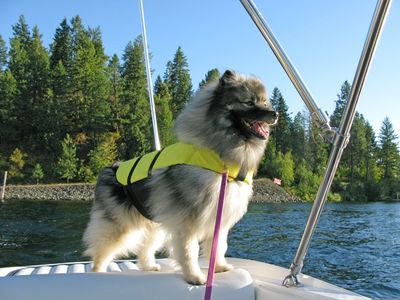
Keeshonds (or more properly, Keeshonden) are originally from northern Europe where they were companions and all-purpose farm dogs. They were also used to guard barges on the rivers and canals in Holland, the Netherlands, earning them the name "Dutch barge dogs," as well as "the smiling Dutchman."
In the late 1700s in Holland, Cornelius De Gyselaar used an image of his dog as a symbol of his political party.
"Kees" was Cornelius' nickname and "hond" means "dog" in Dutch, so the breed came to be known as "Kees' dog," or "Kees-hond." "Kees" is pronounced like the word "case," and "hond" is pronounced as in "Honda."
They were first recognized as a breed by the American Kennel Club in 1930. For more information on the history of the breed, click here.
General Appearance: The Keeshond (pronounced kayz-hawnd) is a natural, handsome, wellbalanced
dog with a short-coupled body. They attract attention by their coloration, alert carriage,
intelligent foxlike expression, characteristic spectacles and small pointed ears. They also have a
stand-off coat and richly plumed tail that is well curled over the back. The coat is very thick
around the neck, fore part of the shoulders and chest, forming a lion-like ruff-more profuse in the
male. The rump and hind legs, down to the hocks, are also thickly coated, forming the
characteristic "trousers". The head, ears, and lower legs are covered with thick, short hair.
Size, Proportion, Substance: The Keeshond is medium-sized and square-appearing. They are
sturdy, with bone in proportion to the overall dog, neither coarse nor lightly made. The ideal
height of fully matured dogs when measured from top of withers to the ground is 18 inches for
males and 17 inches for bitches - a 1-inch variance either way is acceptable. While correct size is
very important, it should not outweigh that of type. When dogs are judged equal in type, the dog
nearest the ideal height is to be preferred.
Head: Expression - Expression is largely dependent on the distinctive characteristic called
"spectacles"- a hallmark of the breed. Spectacles are a combination of markings and shadings in
the orbital area which must include a delicate, dark line slanting from the outer corner of each
eye toward the lower corner of each ear coupled with expressive eyebrows. Markings (or
shadings) on face and head must present a pleasing appearance, imparting to the dog an alert and
intelligent expression. Very Serious Fault - Absence of dark lines which form the "spectacles."
Eyes - Eyes should be dark brown in color, of medium size, almond shaped, set obliquely and neither too wide apart nor too close together. Eye rims are black. Faults - Round and/or protruding eyes or eyes light of color.
Ears - Ears should be small, triangular in shape, mounted high on head and carried erect. Size of the ear is proportionate to the head-length approximating the distance from the outer corner of the eye to the nearest edge of the ear. Fault - Ears not carried erect when at attention.
Skull - The head is in proportion to the body and wedge-shaped when viewed from above. In profile it has a defined stop. The topskull is somewhat flat and in parallel planes with the top of the muzzle. Faults - Apple head or absence of stop.
Muzzle - Of medium length, neither coarse nor snipey, and well-proportioned to the skull. The muzzle, from
tip of nose to stop, should be approximately the same length as from stop to occiput. Mouth - Lips should be black and closely meeting-not thick, coarse or sagging, and with no wrinkle at the corner of the mouth. The teeth should be white, sound and strong meeting in a scissors bite. Faults-Overshot, undershot or wry mouth.
Neck, Topline Body: The neck should be moderately long and set well into the shoulders. The
topline is straight with a slight slope to the hindquarters. The body is well ribbed, compact and
strong with a good spring of rib. The easily felt prosternum is in line with the point of shoulder
with a deep chest that extends approximately to the elbow. The loin is short, with the belly
moderately tucked up. Tail - The tail should be moderately long and well feathered, set on high,
tightly curled over the back and lying close to the body. The tail must form a part of the
"silhouette" of the dog's body, rather than give the appearance of an appendage. Fault - Tail not
lying close to the back.
Forequarters: The shoulder blade, upper arm and forearm are of equal length, with the highest
point of the withers being in line with the elbow. Elbows are held close to the body. Forelegs are
straight seen from any angle and set behind the forechest. Distance from withers to elbows
approximately equals distance from elbows to ground. Ideal shoulder angulation is moderate.
Pasterns are strong with a slight slope. The feet are compact, well-rounded, cat-like. Toes are
nicely arched, with black nails. Dewclaws may be removed.
Hindquarters: The hindquarters are well muscled, moderately angulated, and in balance with
the forequarters. Hocks are perpendicular to the ground, neither under nor extended way behind
the croup. Feet are the same as described in the forequarters section.
Coat: The body is abundantly covered with long, straight, harsh hair standing well out from a
thick, downy undercoat. Head, including muzzle, skull and ears, are covered with smooth, soft,
short hair-velvety in texture on the ears. The neck is covered with a mane-more profuse in the
male-sweeping from under the jaw and covering the whole of the front part of the shoulders and
chest, as well as the top part of the shoulders. The hair on the legs is smooth and short, except for
feathering on the front legs and "trousers" on the hind legs. Hind legs are profusely feathered
down to the hocks-not below. The hair on the tail forms a rich plume. Coat must not part down
the back. Bitch Coat: The bitch coat may be less abundant than that of the male. Bitches should
not be penalized for their shorter coats. They may also carry as much coat as their male
counterparts. The bitch’s coat should reflect her feminine type and appearance, making it easy to
distinguish her from the male. Puppy Coat: The puppy coat may be predominately undercoat. It
may feel soft in texture as it lacks the harsh guard hairs present in adults. The age and rate at
which guard hair grows varies among puppies. Trimming: The Keeshond is to be shown in a
natural state. Trimming permissible only on feet, pasterns, hocks and –if desired—whiskers.
Trimming or sculpting of the coat or any grooming which alters the natural appearance to be
severely penalized. Faults - Silky, wavy, or curly coats.
Color and Markings: A dramatically marked dog, the adult Keeshond is a mixture of gray,
black and cream. This coloring may vary from light to dark. The hair of the outer coat is black
tipped, the length of the black tips producing the characteristic shading of color. The undercoat is
very pale gray or cream, never containing tan, brown, or orange tones. Puppies are often less
intensely marked. The dramatic color and contrast seen in adults may be lacking in some puppies
as they haven’t developed the guard coat that typically determines the variations in the black
color.
Head: The muzzle and ears are dark in color with some natural shading, seldom solid black.
"Spectacles" and shadings, as previously described, are characteristic of the breed and must be
present to some degree.
Ruff, Shoulders and "Trousers”: The color of the ruff and "trousers" is lighter than that of the
body. The light gray shoulder line markings must be well defined.
Tail: The plume of the tail is very light in color when curled on the back, and the tip of the tail is
black.
Legs and Feet: Legs and feet are cream.
Faults - Pronounced white markings. Black markings more than halfway down the foreleg.
Penciling is acceptable on the toes and feet. White foot or feet. Very Serious Faults - Entirely
black or white or any solid color; any pronounced deviation from the color as described.
Gait: The Keeshond movement is clean and brisk with balanced reach and drive. They move
confidently, with the head carried naturally above a steady topline, while keeping the tail tightly
curled over the back. When seen from the side they should not move with extended reach and
drive. There is no overstepping or interfering between the front and rear movement. The
Keeshond is a double tracking breed. The legs move parallel coming and going but as speed
increases the legs tend to slightly converge toward a center line.
Temperament: Temperament is of primary importance. The Keeshond is neither timid nor
aggressive but, instead, is outgoing and friendly with both people and other dogs. The Keeshond
is a lively, intelligent, alert and affectionate companion.
Approved October 8, 2024
Effective January 1, 2025